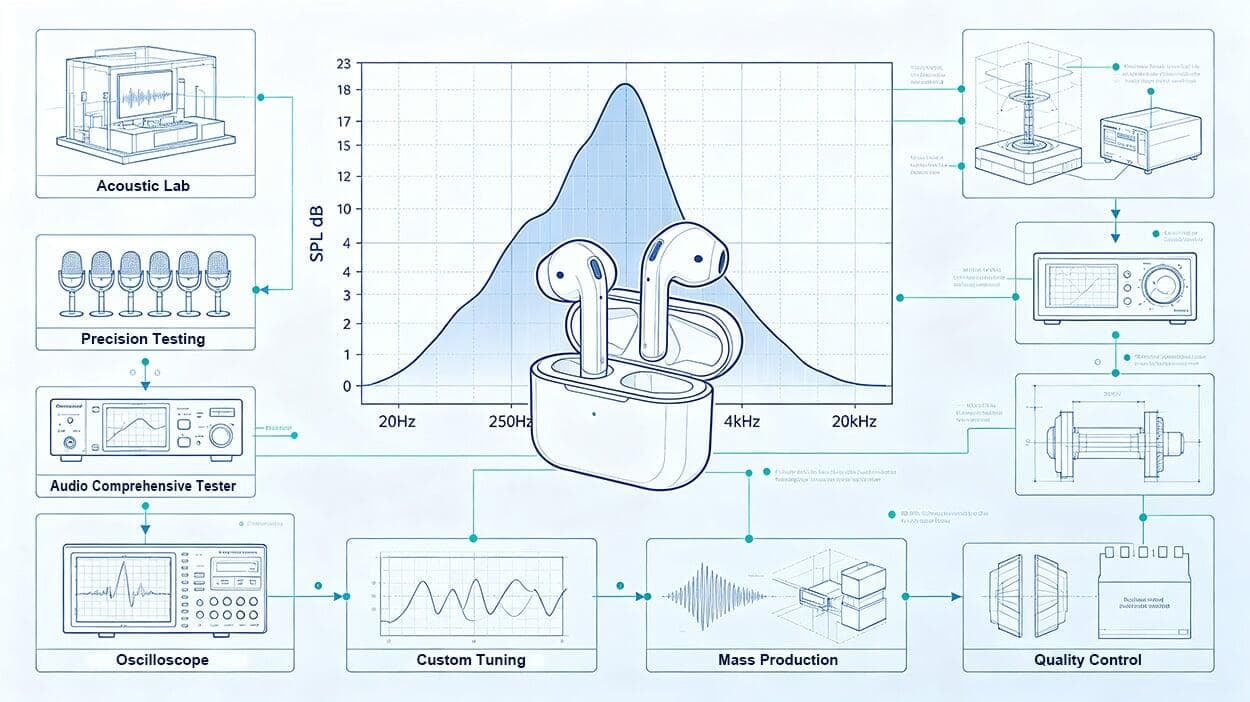
Sound quality is the core competitiveness of premium Bluetooth TWS earbuds, yet many buyers and brand operators judge audio performance merely by subjective listening feelings. In professional audio testing, frequency response graphs serve as the most objective, visual, and authoritative standard to evaluate earbud acoustic performance. This professional guide from EFINIYA will elaborate on how to analyze frequency response charts, interpret acoustic tuning characteristics, and accurately judge the sound quality level of wireless earbuds, helping brands select high-quality earbud solutions and customize targeted audio styles.
The frequency response of TWS earbuds refers to the device’s sound output performance across the full audible frequency spectrum. The human ear can perceive sound frequencies ranging from 20Hz to 20kHz, which covers all tones from deep bass to crisp treble. On a standard frequency response graph, the ahorizontal axis represents the full frequency bandwidth (20Hz–20kHz), while the vertical axis stands for sound pressure level (SPL) in decibels (dB), reflecting the loudness and output gain of the earbuds at each specific frequency point.
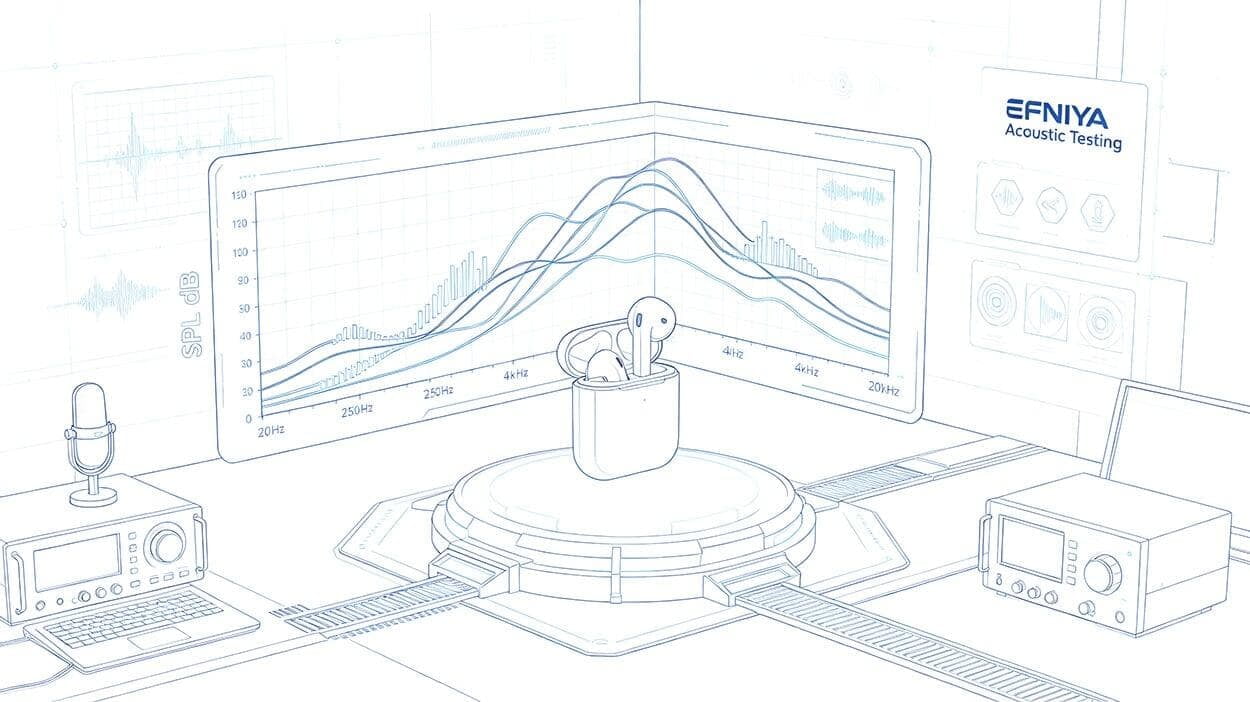
Core Metrics of Standard Frequency Response Graphs
A qualified frequency response curve directly reveals the tuning logic and sound quality flaws of earbuds. Different frequency bands correspond to distinct auditory experiences and audio performance. Mastering the analysis of each band is the key to accurate sound quality evaluation.
1. Flat Frequency Response (Neutral Tuning Standard)
A nearly flat frequency response curve means the earbuds output consistent sound pressure across all frequency bands, without artificially boosting or attenuating any tone. This neutral tuning style can restore the original sound of audio sources truthfully, featuring high fidelity and low sound coloration. It is the preferred standard for professional audio monitoring, music production, and high-fidelity listening scenarios, and also the core tuning benchmark for EFINIYA’s premium earbud series.
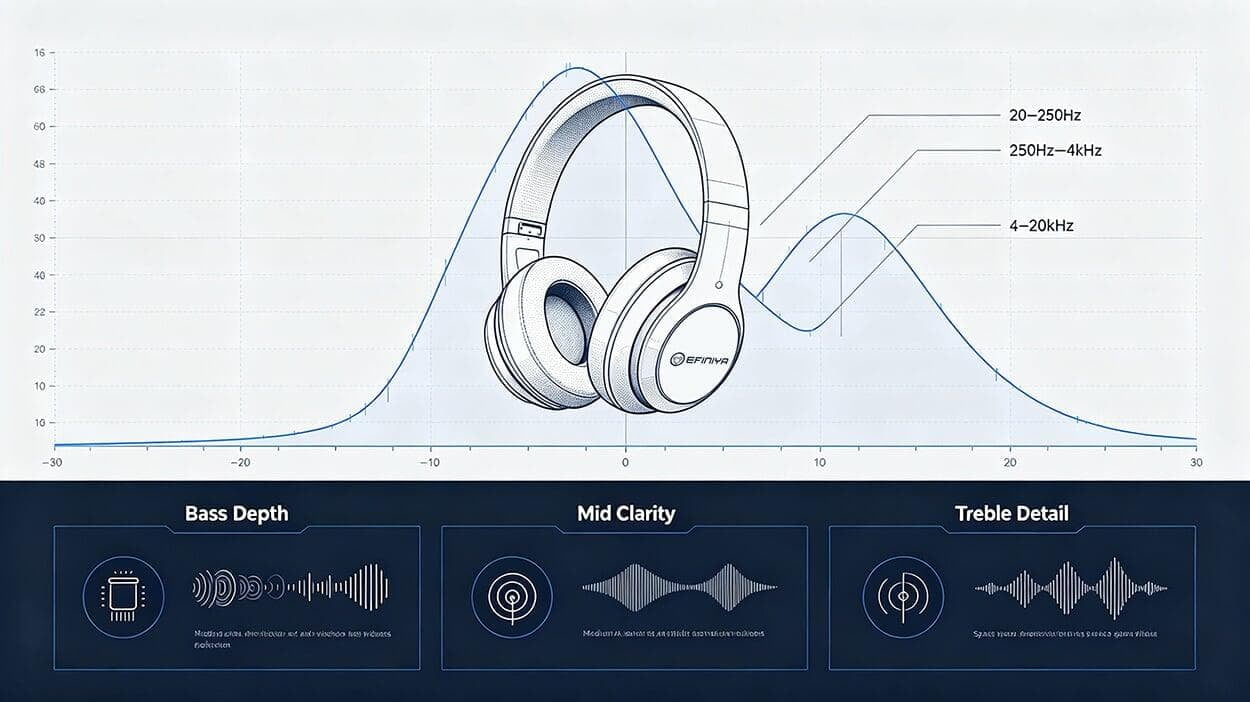
2. Low-Frequency Band (20Hz – 250Hz): Bass Performance Foundation
The low-frequency band dominates the bass depth, texture, and immersive sense of music, covering drum beats, bass, and ambient reverberation. A moderate gain in this band delivers full, warm, and powerful bass, greatly enhancing the rhythm sense of pop music, electronic music, and hip-hop tracks. However, excessive low-frequency boosting will cause bass overflow, mask vocal and instrumental details, resulting in a muddy, bloated sound field and severely damaged audio layering. Conversely, insufficient low-frequency gain leads to thin, hollow bass with no impact or depth.
3. Mid-Frequency Band (250Hz – 4kHz): Core of Vocal and Instrument Details
As the most critical core band for auditory perception, the mid-frequency band carries human vocals and the main tones of most musical instruments, determining the clarity, authenticity, and presence of sound. A balanced and stable mid-frequency curve with no obvious peaks or dips ensures transparent vocals and delicate instrumental details. Sharp peaks in this band will make the sound harsh and sharp, causing auditory fatigue; obvious dips will make vocals sound distant and thin, losing texture and intimacy, which is the most common sound quality defect in low-end earbuds.
4. High-Frequency Band (4kHz – 20kHz): Treble Clarity and Spatial Sense
The high-frequency band controls the brightness, detail resolution, and air sense of audio, including instrument overtones, percussion details, and vocal fine textures. Appropriate treble optimization adds vividness and layering to the sound, restoring delicate music details. Excessive treble gain will produce sharp, sibilant sound and piercing high-frequency noise; while overly attenuated treble makes the sound dull and dim, lacking clarity and three-dimensional spatial sense.
Practical Skills to Evaluate Sound Quality From Frequency Response Curves
1. Match Tuning Style With Target Preferences
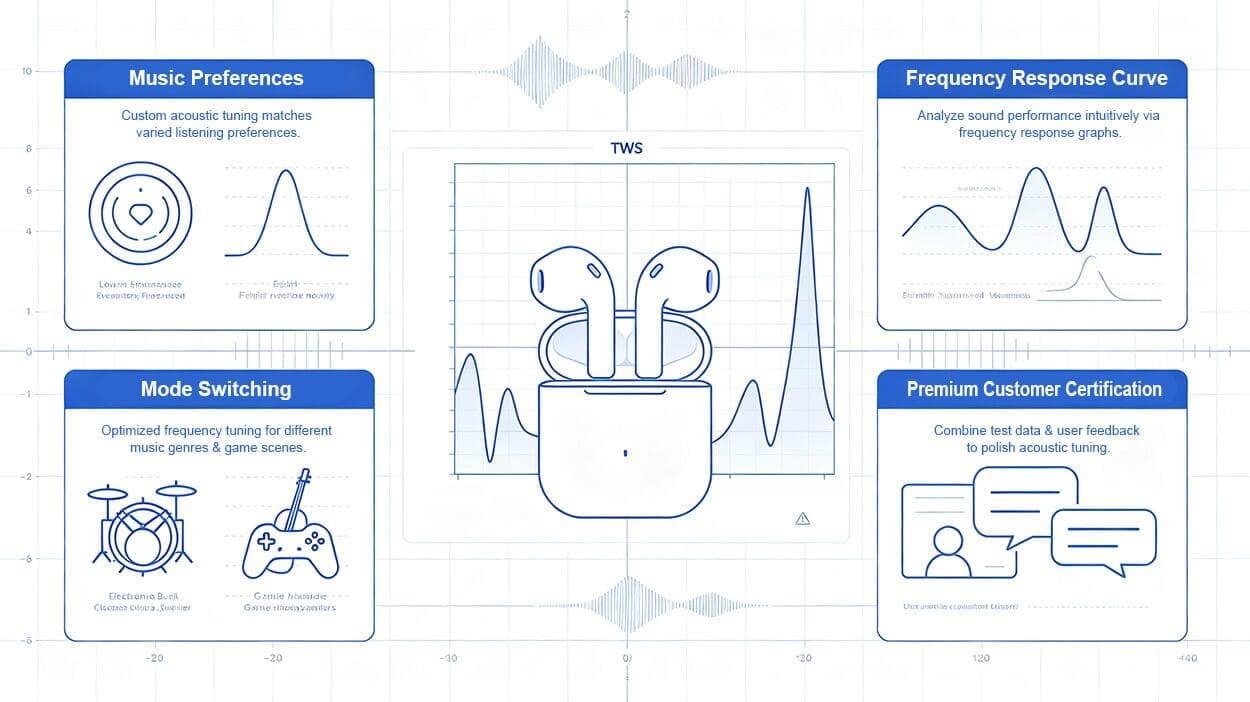
There is no one-size-fits-all “best” frequency response curve—different user groups and usage scenarios correspond to different optimal tuning styles. Young users who love pop and electronic music tend to prefer bass-heavy tuning with enhanced low-frequency gain; audiophiles and classical music enthusiasts pursue flat neutral tuning for high-fidelity restoration; daily commuter earbuds usually adopt balanced tuning with moderate bass and clear mid-treble to adapt to diverse audio content.
2. Prioritize Overall Curve Balance
High-quality earbud sound performance relies on overall curve stability rather than partial excessive optimization. Excellent frequency response characteristics are reflected in smooth curve transitions, no abrupt peaks or deep dips, and balanced gain across low, mid, and high bands. This balanced design ensures accurate restoration of various audio content, presenting natural, comfortable, and layered sound effects, and adapts to most music genres and daily audio scenarios.
3. Adjust According to Music Genre Characteristics
Different music genres have unique frequency band requirements. Dynamic electronic music and dance tracks require sufficient low-frequency support to enhance rhythm and immersion; classical music, folk music, and vocal songs need precise mid-frequency restoration and smooth treble performance to retain delicate details; game audio emphasizes balanced full-band performance to ensure accurate sound positioning and clear sound effects.
4. Verify With Professional Test Data and User Feedback
Frequency response graphs are objective test results, which can be combined with professional audio evaluation data and real user listening feedback for comprehensive judgment. Authoritative test reports can verify the stability of earbud acoustic performance in different environments, while mass user feedback can confirm whether the tuning style meets market public aesthetics, helping brands avoid over-customized niche tuning and improve product market adaptability.
EFINIYA Professional Acoustic Tuning & Customization Strength
As a professional TWS earbuds OEM/ODM manufacturer, EFINIYA has an independent acoustic tuning laboratory and professional audio R&D team. We rely on precise frequency response testing equipment to calibrate every batch of earbud acoustic parameters accurately.
We provide personalized acoustic tuning customization services for global brand clients: according to your brand positioning, target user groups, and product scenario planning, we adjust the gain of low, mid, and high frequency bands, optimize curve smoothness, and create exclusive sound signatures including heavy bass gaming style, neutral high-fidelity style, and balanced daily style. All products pass strict acoustic testing to ensure stable and consistent sound quality of finished products, helping brands launch differentiated and competitive wireless earbud products.
Final Conclusion
Frequency response graphs are the most intuitive and scientific tool to identify earbud sound quality, helping everyone get rid of subjective misleading and accurately judge the advantages and disadvantages of acoustic performance. By analyzing the balance of low-frequency texture, mid-frequency clarity, and high-frequency detail, brands can quickly screen high-quality earbud solutions and complete precise product positioning.
If you are looking for a reliable TWS earbuds manufacturer with professional acoustic tuning capabilities, EFINIYA is your ideal long-term cooperative partner. We provide one-stop services including acoustic customization, structural design, mass production, and quality testing to empower your brand’s audio product upgrading and market expansion.