By EFINIYA Supply Chain & Compliance Team
Selecting a TWS earbuds manufacturer in 2026 is no longer a procurement task—it is a risk management decision. Between tightening EU battery regulations, evolving wireless standards (Bluetooth 6.0, LE Audio), and rising consumer expectations for ANC performance and sustainability, the gap between a “supplier” and a strategic manufacturing partner has never been wider.
Many brands still approach sourcing with a checklist mindset: price, MOQ, lead time. But in today’s regulatory and competitive environment, that mindset creates hidden liabilities—non-compliant shipments, inconsistent batch quality, and reputational damage.
At EFINIYA, we work with global audio brands to de-risk their product launches. Below is a structured evaluation framework designed for serious buyers who want more than a factory—they want a partner who can protect their brand in the EU and beyond.
1. Compliance: From Certificates to Audit Readiness
Compliance is not a static document—it is a continuously maintained system. When evaluating a TWS OEM, look beyond surface-level claims.
Regulatory Layer | What to Request | Why It Matters in 2026 |
|---|---|---|
CE / RED (2014/53/EU) | Full test reports (RF, EMC, SAR if applicable), EU Declaration of Conformity tied to your model name | Required for legal EU market entry; must match shipped product exactly |
RoHS & REACH | Material disclosure reports for PCBA, battery, plastics; SVHC declarations | Increasingly enforced via market surveillance; non-compliance risks recalls |
UN38.3 & IEC 62133 | Battery cell + pack test reports; transportation-safe packaging validation | Mandatory for air freight; critical for EU battery regulation alignment |
EU Battery Regulation (2023/1542) | Evidence of removable/replaceable battery design; carbon footprint disclosures | Compliance deadline Feb 2027; early movers gain competitive advantage |
ISO Quality Systems | ISO 9001 (quality), ISO 14001 (environmental), ISO 45001 (safety)—specific to manufacturing site | Indicates systemic process control, not just one-off certifications |
✅ EFINIYA Practice: Our compliance dossiers are structured for market-surveillance readiness, including batch-level traceability and digital document archiving—so your brand can respond to EU authority requests within days, not weeks.
2. Acoustic Performance: Validated, Not Claimed
ANC and audio quality are often where supplier promises break down. Move from marketing language to measurable validation.
- ANC Validation: Request frequency-domain attenuation curves (not just dB numbers). Independent lab testing (e.g., HEAD acoustics, Brüel & Kjær) is ideal.
- Audio Tuning Capability: Ask whether the OEM can provide target response curves aligned with your brand’s sound signature—and whether they use objective measurement rigs (ear simulators, GRAS couplers).
- ENC Call Quality: Evaluate voice pickup in noisy environments using standardized test signals (e.g., ITU-T P.501).
✅ EFINIYA Advantage: We operate an in-house anechoic chamber and audio tuning team, enabling brand-specific DSP calibration and reproducible performance across production batches.
3. Engineering Maturity: Beyond Assembly
A reliable OEM should demonstrate design ownership, not just contract assembly.
Key indicators:
- Proprietary structural designs (e.g., modular battery compartments, antenna isolation techniques)
- DFMEA (Design Failure Mode and Effects Analysis) documentation
- Firmware customization capability (touch logic, EQ presets, multi-point connection behavior)
- Tooling control: who owns the molds, and how are they protected?
✅ EFINIYA Approach: We provide private-tooling programs with IP protection agreements, ensuring your product architecture remains exclusive and compliant with EU repairability requirements.
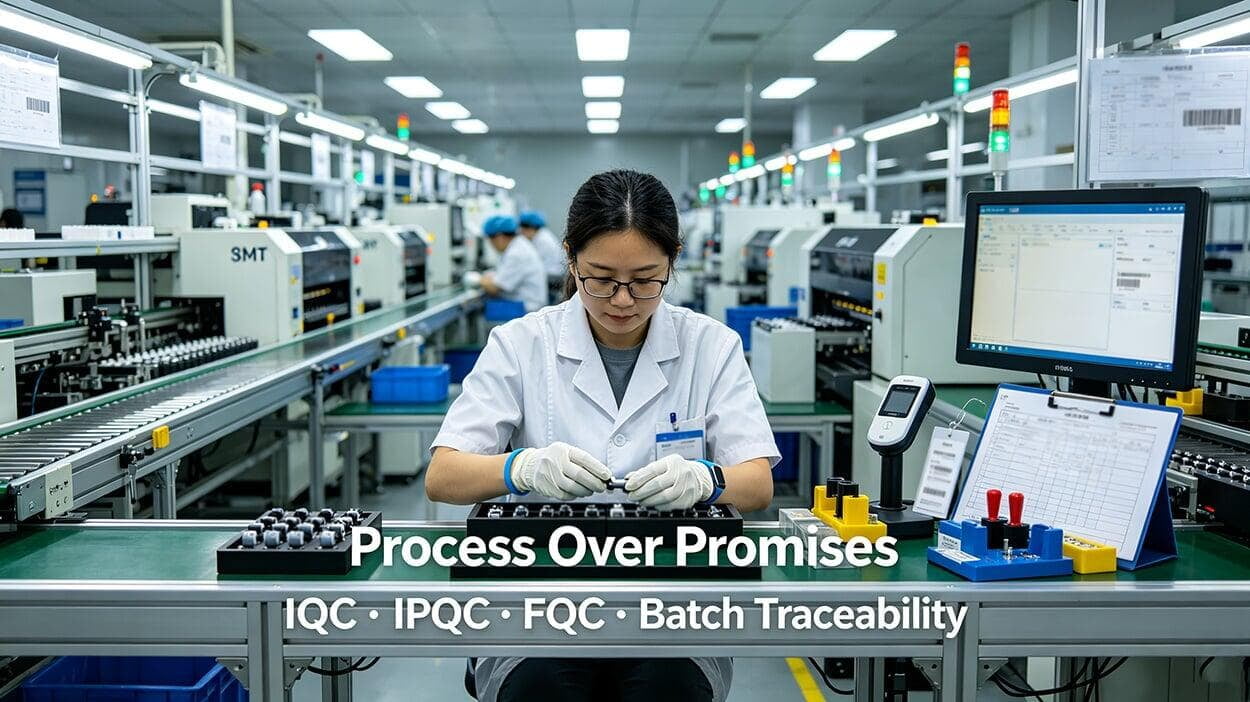
4. Quality Assurance: Process Over Promises
QC should be documented, repeatable, and transparent.
Evaluate:
- IQC (Incoming Quality Control) for key components (battery cells, Bluetooth modules, drivers)
- IPQC (In-Process Quality Control) with checkpoint records
- FQC (Final Quality Control) including functional testing and cosmetic inspection
- Batch traceability: can the OEM trace a defective unit back to a specific production shift and component lot?
✅ EFINIYA System: Our MES (Manufacturing Execution System) links every unit to its test data, enabling precise root-cause analysis and selective recall if needed.
5. Commercial Clarity: Pricing, MOQ, and Lifecycle Support
Avoid suppliers who obscure the economics of production.
Red flags:
- Unrealistically low MOQs without explanation of tooling strategy
- Vague pricing that excludes critical elements (charging case, accessories, compliance documentation)
- No clarity on spare-part availability or end-of-life support
✅ EFINIYA Model: We provide transparent cost breakdowns, realistic MOQ planning, and 7–10 year spare-part continuity, aligning with EU expectations for product longevity.
6. Verification Protocol: Trust, Then Verify
Before committing, implement a structured verification sequence:
- Document Audit: Request and independently verify all compliance certificates.
- Engineering Sample Testing: Order a fully customized prototype; test ANC, audio, battery, and mechanical robustness.
- Factory Validation: Conduct a live video audit or on-site visit focused on QA stations and compliance documentation storage.
- Reference Checks: Speak with existing EU clients about documentation accuracy, batch consistency, and after-sales responsiveness.
- Third-Party Inspection: Engage an independent QA firm for pre-shipment inspection or lab validation.
Common Pitfalls (Real-World Patterns)
- Spec–Reality Gap: Samples perform well; mass production quietly downgrades components.
- Compliance Drift: Certificates exist, but product revisions are not re-certified.
- Communication Breakdown: Technical questions met with vague or delayed responses.
- Logistics Blind Spots: Missing or mismatched documents causing EU customs delays.
Conclusion: Partnering for Long-Term Success
In 2026, choosing a TWS earbuds OEM is less about finding the lowest cost and more about protecting your brand equity. The right partner helps you navigate regulation, maintain consistent quality, and adapt to fast-moving technology shifts.
EFINIYA combines acoustic engineering, regulatory expertise, and transparent manufacturing systems to help global audio brands launch with confidence—whether you are entering the EU market for the first time or scaling an established product line.
📩 Contact EFINIYA to request our 2026 TWS OEM Evaluation Toolkit or schedule a technical consultation.