By EFINIYA Compliance & Engineering Team
For global audio brands, the European Union is no longer just another market—it is the most strictly regulated one. Under EU Battery Regulation (Regulation 2023/1542), portable electronic devices, including Bluetooth headphones and TWS earbuds, must meet stringent new requirements around battery design, documentation, and lifecycle management.
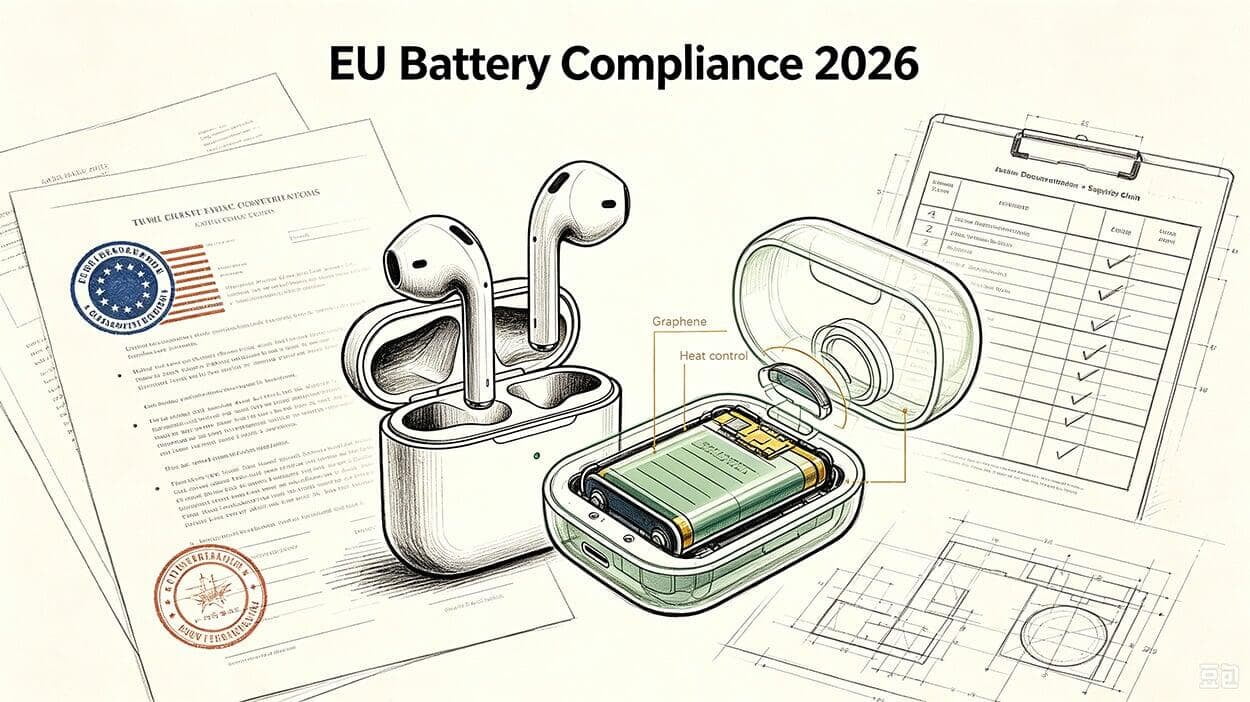
By February 2027, all new models placed on the EU market must allow safe, user-accessible battery removal and replacement. Sealed-in battery designs—still common in many current TWS products—will no longer be compliant. For brands building their 2026–2027 product roadmap, selecting an OEM partner with proven regulatory expertise is no longer optional.
At EFINIYA, we support global clients in navigating this transition through compliant structural design, certified components, and complete technical documentation packages. Below is a practical framework for evaluating any Bluetooth audio manufacturer against EU battery compliance standards.
1. Regulatory Alignment: More Than a Certificate
Compliance is not a single document—it is a system. When assessing an OEM, verify that they can provide:
Requirement | What to Request | Why It Matters |
|---|---|---|
CE / RED Compliance | Full test reports under Radio Equipment Directive (2014/53/EU), including safety, EMC, and RF | Confirms the product legally enters the EU market |
RoHS Declaration | Material analysis reports for PCBA, battery cells, plastics, and cabling | Ensures restricted substances (Pb, Cd, Hg, etc.) are within legal limits |
UN38.3 Battery Certification | Official UN38.3 test report for the exact battery model used | Mandatory for air freight and carrier acceptance |
Battery Removability Evidence | Engineering drawings, exploded-view diagrams, disassembly videos | Demonstrates compliance with EU 2027 removability requirement |
Technical File Package | Complete dossier: test reports, bill of materials, MSDS, user manual, EU DoC | Required for market surveillance and audits |
✅ EFINIYA Advantage: Our technical files are structured according to EU market-surveillance expectations, reducing the risk of post-market enforcement actions.
2. Design Capability: From Sealed to Serviceable
Many factories can assemble earbuds—few can redesign them for compliance without compromising durability or waterproofing. Key questions to ask:
- Can the OEM demonstrate IP-rated enclosures with user-replaceable batteries?
- Do they have experience with tool-less or semi-tool-less battery access?
- Can they provide design failure mode analysis (DFMEA) for the new structure?
✅ EFINIYA Practice: We have developed proprietary modular battery compartment designs that maintain IPX4–IPX5 ratings while complying with EU removability rules—ideal for sports and outdoor audio segments.
3. Supply Chain Transparency
A compliant product requires a compliant supply chain. Evaluate whether the manufacturer:
- Sources battery cells from EU-approved suppliers
- Maintains batch-level traceability (cell lot numbers, MSDS, COC)
- Provides carbon footprint disclosures (increasingly requested under EU due diligence rules)
✅ EFINIYA Practice: We operate a managed battery supply chain with full upstream documentation, enabling our clients to respond quickly to EU authority inquiries.
4. Verification Workflow: Don’t Rely on Paper Alone
Documents can be forged—products cannot. Implement a multi-step verification process:
- Legal Entity Check – Confirm business license and export history.
- Engineering Sample Review – Physically test battery removal and reinsertion.
- Independent Lab Testing – Validate EMC, safety, and battery performance claims.
- Reference Validation – Speak with existing EU customers about documentation accuracy and after-sales support.
- Pre-Shipment Inspection – Engage a third-party inspector for pilot runs.
✅ EFINIYA Support: We welcome third-party inspections and provide access to our internal QC data for client peace of mind.
5. After-Sales and Lifecycle Support
EU regulations emphasize product longevity and repairability. A future-proof OEM should offer:
- Spare battery availability for minimum 7–10 years
- Clear service manuals for technicians and end-users
- Warranty policies aligned with EU consumer protection expectations
✅ EFINIYA Advantage: Our after-sales program includes authorized spare-part distribution, ensuring your brand remains compliant throughout the product lifecycle.
Conclusion: Compliance as a Competitive Advantage
In 2026, EU battery compliance is not just a legal hurdle—it is a market differentiator. Brands that adopt compliant designs early will enjoy smoother market access, stronger retailer relationships, and reduced regulatory risk.
EFINIYA combines regulatory expertise, compliant structural design, and transparent supply chains to help audio brands launch EU-ready Bluetooth headphones and TWS earbuds with confidence.
📩 Contact EFINIYA today to request our EU Battery Compliance Whitepaper or schedule a technical review of your next product design.